

The origins of healthcare in Headington
The Radcliffe Infirmary was Oxford’s first modern hospital when it opened in 1770, and it was the Infirmary trustees who took the initiative to found the Warneford Hospital, which opened in 1826.
The Warneford was a pioneer in treating mental illness with dignity and was the first “Oxford” hospital to be located in Headington, outside the city boundaries.
Growth of the Warneford estate
For 125 years the Warneford Hospital grew steadily within a pastoral setting that shaped its patient care regimes. It was well endowed and, by 1940, owned some 150 acres of landscaped grounds and adjoining farmland.
Development of Oxford’s hospital cluster
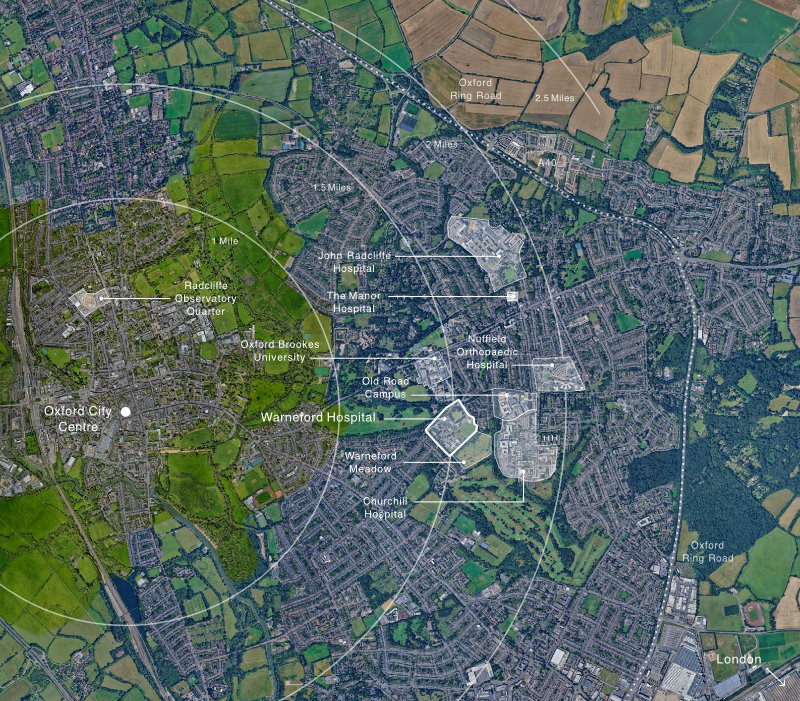
The Churchill Hospital was built in 1942 for wartime use by US forces on part of this estate. The adjoining Nuffield Orthopaedic Hospital followed in 1948, and the John Radcliffe and Acland Hospitals between 1972 and 2011.
In parallel, the University purchased the Old Road Campus in 1996 and the Park Hospital in 2007, both of which derived from the historic Warneford land holdings.
Headington as a major medical sciences hub
All of Oxford’s hospitals and the centre of gravity of the University’s top-rated Medical Sciences Division have thus re-located “up the hill” to Headington over the past 85 years.
Together with Oxford Brookes nursing faculty, they now make up one of Europe’s leading healthcare and medical sciences ecosystems, employing almost 30,000 staff.
The Warneford site today
The other healthcare sites in Headington are now reaching saturation. By contrast, the 21‑acre Warneford site has seen only modest buildings and extensions added incrementally to its historic core since 1914.
The University Psychiatry Department was founded there in 1969, but the site retains much of its mature landscape setting and is enhanced by the adjoining 18‑acre Meadow, which has protected Town Green status.